IN AN EMERGENCY, CALL 000
Refer to Emergency WA for current alerts, warnings and Fire Danger Ratings
Click the buttons below to see more about that topic.
Documents:
The requirements of the Fire Prevention Order (the Order) are the minimum standard needed to help reduce the risk of bushfire to people, property and the community.
In accordance with Section 33 of the Bush Fires Act 1954, all owners and occupiers of land within the Shire of Donnybrook Balingup are legally required to carry out fire prevention and fuel hazard reduction works on their property.
Even if your property is subject to a Bushfire Management Plan, development conditions or previous approvals, you must still comply with the Order. Alternative measures may only apply if you have written approval from the Shire.
In addition to the requirements of this Order, the Shire may issue special orders to owners or occupiers if further hazard removal is considered necessary. Inspections are carried out by an Authorised Officer (Shire Rangers). Some areas of the Shire are also subject to mitigation work, which is carried out by the Shire's Bush Fire Brigades and employees.
A copy of the Order, along with a list of current authorised Bush Fire Control Officers, is sent with annual rates notices every year. It is also published online (see below), and is suitable for standard A4 printing should you require additional copies.
IMPORTANT - Action Required
All required works must be completed by the following:
- Within a townsite: 1 November 2026
- Outside of townsites: 15 November 2026
- All properties must be maintained until 31 March 2027, or within 14 days of becoming an owner/occupier of land.
Authorised Officers will monitor all properties in the Shire for compliance from 1 November to 31 March each year.
Failure to comply may result in:
- On-the-spot fines (from $250)
- Prosecution (up to $5,000)
- Council carrying out works at your cost
Can't comply?
If compliance is impractical or may cause environmental harm, you may apply to the Shire for approval of alternative fire prevention measures – applications must be received in writing by 30 September annually.
Property Categories
Do you know what applies to you and your property? Refer to the categories below for further details about what is required, and when it needs to be done by.
CATEGORY 1: Townsite Land
Properties 2,024m² or less – compliance required from 1 November to 31 March
- Remove all flammable material (except living plants)
- Keep grass trimmed below 10cm
- Vacant land? Slash, mow, and remove all flammable material
CATEGORY 2: Land Zoned Rural Residential, Rural Small Holding or Tourist
Properties over 2,024m², up to 4 hectares – compliance required from 15 November to 31 March
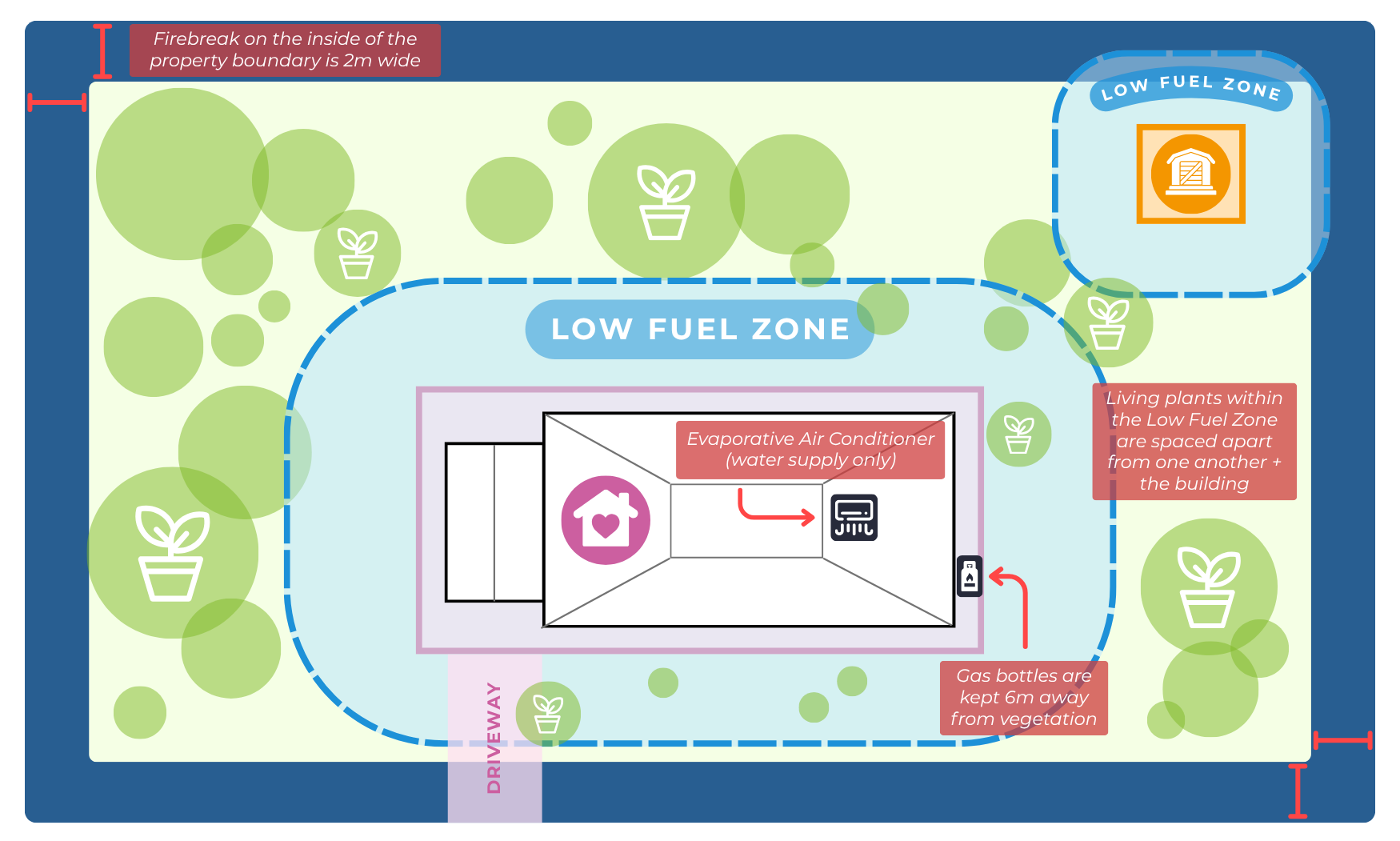
- 2m wide firebreaks inside all property boundaries with 4m vertical clearance
- Slash and remove all flammable material around all buildings, haystacks and fuel storage areas (excludes living plants)
- Keep grass trimmed below 10cm
- 2m clearance around all garden refuse and wood piles
- 20m Low Fuel Zone around all buildings
- Unmanaged land must have firebreaks and full fuel reduction
- Managed land must have active fuel reduction throughout the compliance period by means of slashing, bailing and/or grazing. Firebreaks, while not compulsory, are encouraged in strategic locations.
CATEGORY 3: Rural Properties Zoned General Agriculture or Priority Agriculture
Properties over 4 hectares – compliance required from 15 November to 31 March
- Access tracks to all buildings (3m wide with 4m vertical clearance)
- 20m Low Fuel Zone around buildings, haystacks and fuel storage areas
- Keep grass trimmed below 10cm
- Unmanaged land, excluding plantations, must have firebreaks as near as practical to the perimeter of the property or full fuel reduction (excludes living plants).
- Managed land, excluding plantations, must have active fuel reduction throughout the compliance period by means of slashing, bailing and/or grazing. Firebreaks, while not compulsory, are encouraged in strategic locations.
CATEGORY 4: Plantations
Includes harvested plantations – compliance required from 15 November to 31 March
- 10m wide firebreaks inside all property boundaries
- Internal firebreaks, minimum 6m wide, to limit compartment size to 28 hectares in area
- Minimum 5m vertical clearance above firebreaks
CATEGORY 5: Fuel and/or Gas Depots
Compliance required from 15 November to 31 March
- Entire property to be kept clear of all flammable material
- 3m wide firebreaks inside all property boundaries with 4m vertical clearance
Bush Fire Control Officers
The contacts listed below are authorised Bush Fire Control Officers (BFCO) for the 2026-2027 period.
- CHIEF BFCO: Max Walker – (08) 9764 1021 / 0428 641 021
- DEPUTY CHIEF BFCO:
- Bevan Dix – 0429 579 571
- Tim McNab – 0419 094 606
- ARGYLE & IRISHTOWN: Jayden Hitchcock – 0459 990 087
- BALINGUP TOWNSITE: Paul Davis – 0439 091 717
- BEELERUP: Stuart Simmonds – 0429 371 842
- BRAZIER & KIRUP: Chris Wringe – (08) 9731 6168 / 0427 316 168
- BROOKHAMPTON: Tim McNab – 0419 094 606
- DONNYBROOK TOWNSITE: David Tooke – (08) 9731 1330 / 0428 920 045
- FERNDALE: Jamie Thomson – 0448 836 463
- LOWDEN: Michael Anderson – 0408 321 316
- MULLALYUP: Rob Seaton – 0459 440 431
- MUMBALLUP:
- Brendon Giudici – 0488 591 458
- Garth Fitzpatrick – 0438 761 982
- MUNRO: Tas Thamo – 0427 641 148
- THOMSON BROOK: Graham Foan – (08) 9731 8104 / 0429 311 840
- UPPER CAPEL: Bevan Dix – 0429 579 571
Low Fuel Zones
A Low Fuel Zone is an area around buildings, fuel storage areas and other important assets where grass, leaves and other flammable material are kept low and well managed. Separate from firebreaks, Low Fuel Zones provide an extra layer of protection by reducing how easily a fire can start, spread or intensify.
They help protect families, livestock and homes by lowering fire intensity, giving firefighters safer conditions to work, and giving people a better chance to leave safely when a bushfire threatens.
If your property requires a Low Fuel Zone...
The following applies to all properties that require a Low Fuel Zone
- Keep grass trimmed below 10cm
- Lawns to be kept short and green, where possible
- Flammable material reduced and regularly maintained (includes dry grass, leaves and debris)
- Be kept clear of excess flammable material, excluding living trees and shrubs where appropriate
- Be actively maintained for the entire compliance period (not just once off), supported by ongoing reduction such as slashing, baling and grazing
Requirements for Living Plants in a Low Fuel Zone
- Tree crowns are a minimum of 10m apart from one another
- Trees are skirted or pruned up to a height of 2m
- No trees located within 2m of a building (measured from the tree crown)
- Tree branches not hanging over any buildings
- Shrubs to be away from buildings and have a clear gap at a distance of 3 times its height at maturity (measured from the shrub crown)
- No elevated dead material within the crowns of all trees and shrubs
What does a compliant property look like?
The following example illustrates how a Category 2 property can meet the requirements of this Order (as at July 2026)
Definitions & Regulated Activities
The following activities have extra fire safety requirements, and apply to all properties. The key words and definitions listed below are as defined in the Fire Prevention Order.
Grinding, Welding & Cutting Equipment
- Only permitted if an operational 400L firefighting unit is within 200m of your activity
- A cleared area of at least 5m surrounding the work area must be free of all flammable materials
Burning Garden Refuse
- Not permitted on land less than 2024m² or situated within a townsite without approval from the Shire – refer to the Animals, Environment and Nuisance Local Law 2017
- 3m cleared area around the burn site
- Not permitted during the Prohibited Burning Period
- Permit required during Restricted Burning Periods
Slashing
- Residential lawn mowing is exempt
- Operational 9kg fire extinguisher required during Restricted and Prohibited Burning Periods
- Operational 400L firefighting unit required during Prohibited Burning Periods (in addition to above)
Roadside Verges
- Council’s Permits for Road Verges Policy (EMERG/CP-02) states that no verge is to be burnt without a permit
- Please contact the Shire Administration Office to discuss.
Campfires & Solid Fuel Cooking
- Permits required during Restricted Periods, and when Fire Danger Rating is High or above during Unrestricted Burning Period
- Not permitted during the Prohibited Burning Period or during a Total Fire Ban
- Gas barbecues are permitted – minimum 5m cleared area surrounding the barbecue required
Incinerators
- Incinerators must not be used when the Fire Danger Rating is High or above.
- An open drum, with or without a lid, is NOT an authorised incinerator.
Access Tracks (definition)
A formed track or driveway that provides vehicle access to buildings or assets, suitable for use by residents and emergency vehicles, including firefighting appliances.
Firebreak (definition)
A strip of land that helps stop fire spread and allows firefighting access, cleared to bare mineral earth and free of grass and flammable material.
Note: Firebreaks and Low Fuel Zones are not the same, and are separate from one another.
Flammable Material or Fuel Hazard (definition)
Anything that can carry fire such as grass over 10cm, leaves, bark, twigs, timber or rubbish (excludes living trees, shrubs and gardens).
Haystack or Wood Pile (definition)
Any grouped or stacked hay, fodder or firewood.
Fuel Storage Area (definition)
Any location or place where flammable fuels are stored or kept on a property such as:
- Fuel tanks (diesel, petrol or similar)
- Gas bottles or LPG tanks
- Drums or containers of fuel or oil
- Areas to dispense or transfer fuel
- Fuel stored for machinery, generators or pumps
Plantation (definition)
Land planted with pine, eucalypt or other commercial trees (excludes orchards and vineyards).
Managed Land (definition)
Land that is actively used for agriculture, viticulture, horticulture, or similar purposes.
Unmanaged Land (definition)
Land that is not actively used, and where active fuel reduction is not occurring.